Author: thediceyreview

  • World’s Fair 1893: Gateway to Fun!

    World’s Fair 1893: Gateway to Fun!

    Ticket to Ride is a fantastic gateway game to draw people into our hobby. It’s my go to suggestion for anyone asking, “Hey I think my *insert relative or friend here* likes games. What would be a good game to start them on?” One of the reasons that it’s my go to suggestion is not just because of its simplicity, it’s also because of its strategic depth that can keep seasoned gamers engaged as well. The game is also educational and can draw people in who love the fun, colorful artwork. For these reasons Ticket to Ride is one of those rare gems on the level of Catan and maybe a Stone Age or King of Tokyo that can engage experienced gamers and wow new prospects at the table. Now you may be asking yourself, “Paul, why on earth did you title a post World’s Fair 1893 and ramble on about Ticket to Ride?” Well friend let me tell you why I think the two are linked.

    For a long time after playing Ticket to Ride I struggled to find a game that could unseat it as my “gateway” suggestion…and I tried. As much as I love Ticket to Ride the theme of building train routes doesn’t make me jump up off the seat and yell “Tell me more!”. I have looked and looked for a game that I could suggest that would perform better with varied groups of people and while I found some great contenders none of the others that I found can knock Ticket to Ride as my go to starter suggestion. That was until recently when I played World’s Fair 1893. I think this one may rival Ticket to Ride as my go to gateway from this day forward.

    Now let me tell you right off the bat, this game will not just be pigeon holed in my collection as my “gateway game”. I play it regularly and absolutely love it. The game is fantastic. If you don’t want to read the rest of the review that’s the meat of the message here. If you want to stick around so I can make my case then please read on because I want to unpack why I think this game is so great.

    OLYMPUS DIGITAL CAMERA

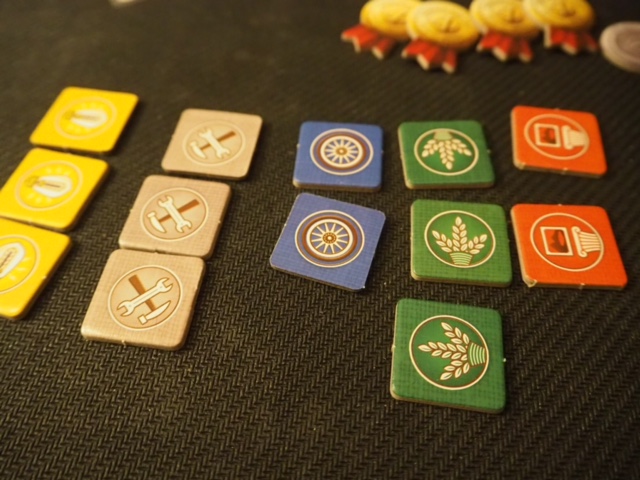
    On a high level World’s Fair 1893 is a simple area control game that has players trying to propose and approve new exhibits for the World’s Fair. If you have the most control in one of the general areas of interest (Transportation, Electricity, Fine Arts, Agriculture, and Manufacturing) at the end of each round you can have those exhibits approved for end game points. Certain influential people from that era such as Bertha Palmer or George Westinghouse will increase your influence with the fair and help you gain more control. You will also receive midway tickets from time to time that will provide you with money throughout the game. Whoever has the most money and points from approving exhibits at the end of the game wins.

    OLYMPUS DIGITAL CAMERA

    Now for the unpacking! World’s Fair ticks a lot of boxes for me with theme, presentation, and approachability. I finally had the chance to pick up a copy at my friendly local game store Madness Games and Comics, and was beyond impressed. From the get go I found the game fun to play. I also found the game incredibly intuitive to grasp. The mechanics are solid and extremely easy to teach. You will place a cube in one of the areas of influence, you will play any influential figures to increase your influence further, you will collect the cards from the area that you placed, you will deal new cards. This pattern is the meat of the entire game. Some of the cards that you collect will be midway tickets that will move the round tracker; a ferris wheel car that moves around as you play (how cool right?!). Once the ferris wheel makes a full circle, the round is over and scoring begins, you do this for three rounds.

    OLYMPUS DIGITAL CAMERA

    That’s the whole game. That pattern of play is all players are required to learn. As players learn the game and become more experienced however they will begin to see the intricacies of the player interaction and strategy. There is so much depth here. At the end of the game players will earn a higher bonus if they can approve sets of different attractions (one each from the five influence areas listed earlier). So for instance at the end of the game if you can approve one attraction each from the Transportation, Agriculture, Electricity, Fine Arts and Manufacturing areas you will receive 15 points. Individually those exhibits are only worth 1 point each. Now if you can get three of the five or four of the five you will receive a higher bonus as well but you will receive the highest score from complete sets. Knowing this about the the game will help you read your opponents and what they are needing, and create an incredible game of cat and mouse. You are trying to complete the most exhibits to further your goals but also prevent your opponents from completing theirs and this balance can be incredibly tense. The gameplay here is fantastic.

    OLYMPUS DIGITAL CAMERA

    The other aspect of this game that I love is the theming and historical information. As I played the game I found myself looking at the different exhibit cards and influential people and being drawn in by the tidbits of information on them. I learned so much about the fair and the type of technology that was on display and being utilized. Games can be very educational and informative but most of the time they are about mechanics and may focus on a fantasy theme. This game will teach you something about history that is fascinating and fun to discuss. You will learn about the influential people that helped to shape the country and the fair. You will only get a couple of sentences about each person and exhibit but I now know about some of the people that were pioneers in our country’s industrial and technological development. The theme of this game is brilliant and shines through the play experience.

    OLYMPUS DIGITAL CAMERA

    Overall World’s Fair 1893 is a brilliant experience for new and experienced gamers alike. If I’m suggesting a game for new enthusiasts, I may still give Ticket to Ride as one of the top 3 but this one will be included as well. If you’re an experienced gamer (who else googles tabletop game blog right?) then you should absolutely pick this game up. World’s Fair 1893 is in that rare air of easy, quick, fun games that provide great strategic depth. The game will cost you $39.99 at your friendly local game store and about $25.99 at Miniature Market and CoolStuffInc. At these prices the value you will get for this game is fantastic and I would absolutely recommend buying the game and keeping it in your collection for a long time. I rated this game as an 8 on board game geek and that rating may climb. I’ve included a how to play video below if you want to see how the game plays and looks on the table. Thanks so much and until next time I’ll see you at the table.

  • Scythe: Elegant Depth

    Scythe: Elegant Depth

    I have a copy of Scythe on pre-order, but I probably won’t be getting it until October. When my friend Guy told me that his Kickstarter deluxe edition had showed up, I couldn’t over there fast enough to play it. Both because I love hanging out with Guy and his wife April, and because Scythe! It took me approximately 10 minutes into playing Scythe to realize that I would love this game.

    It starts when you open the box. From the get-go the artwork is amazing on the cover of the box, and as you unpack the contents it just, gets, better. Each of the components are high quality and beautiful… but wait; I don’t want to spend too much time talking about the amazing components because this is a collector’s edition and you won’t be able to get these super high quality upgraded components. Except that you can. Because the metal coins and larger board and realistic resource tokens and extra faction specific combat power dials and extra encounter cards will all be available from Stonemaier Games store or the BGG marketplace. So if you missed out on the collector’s edition you can still get all of the amazing, beautiful upgraded components.

    But enough about bits, onto the game. Because there is plenty to talk about when it comes to this game. In Scythe you are playing the leader of one of five factions in an alternate reality 1920’s Eastern Europa. Your goal is to make your faction the richest and most powerful faction by conquering territories, enlisting new troops, building buildings, upgrading your production and constructing huge mechs for combat. This may sound like a pretty straightforward 4x game, and in a way it is. But it’s also so much more.

    You start off at your faction’s home base with your awesome faction specific character mini with your awesome animal companion. They are awesome in case you were wondering. The minis really add some flair to your faction, and they look great.
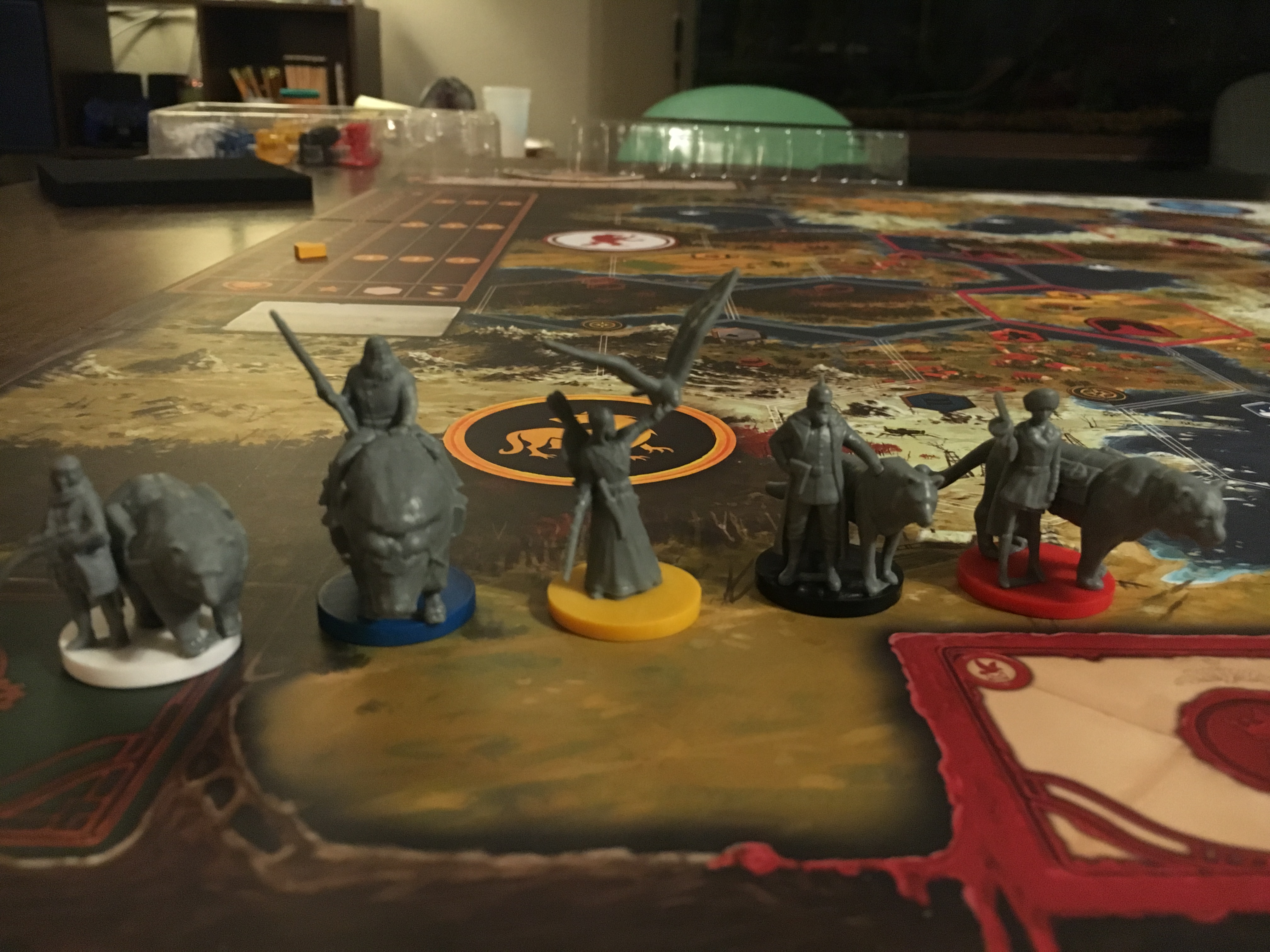
    File_000 (1)

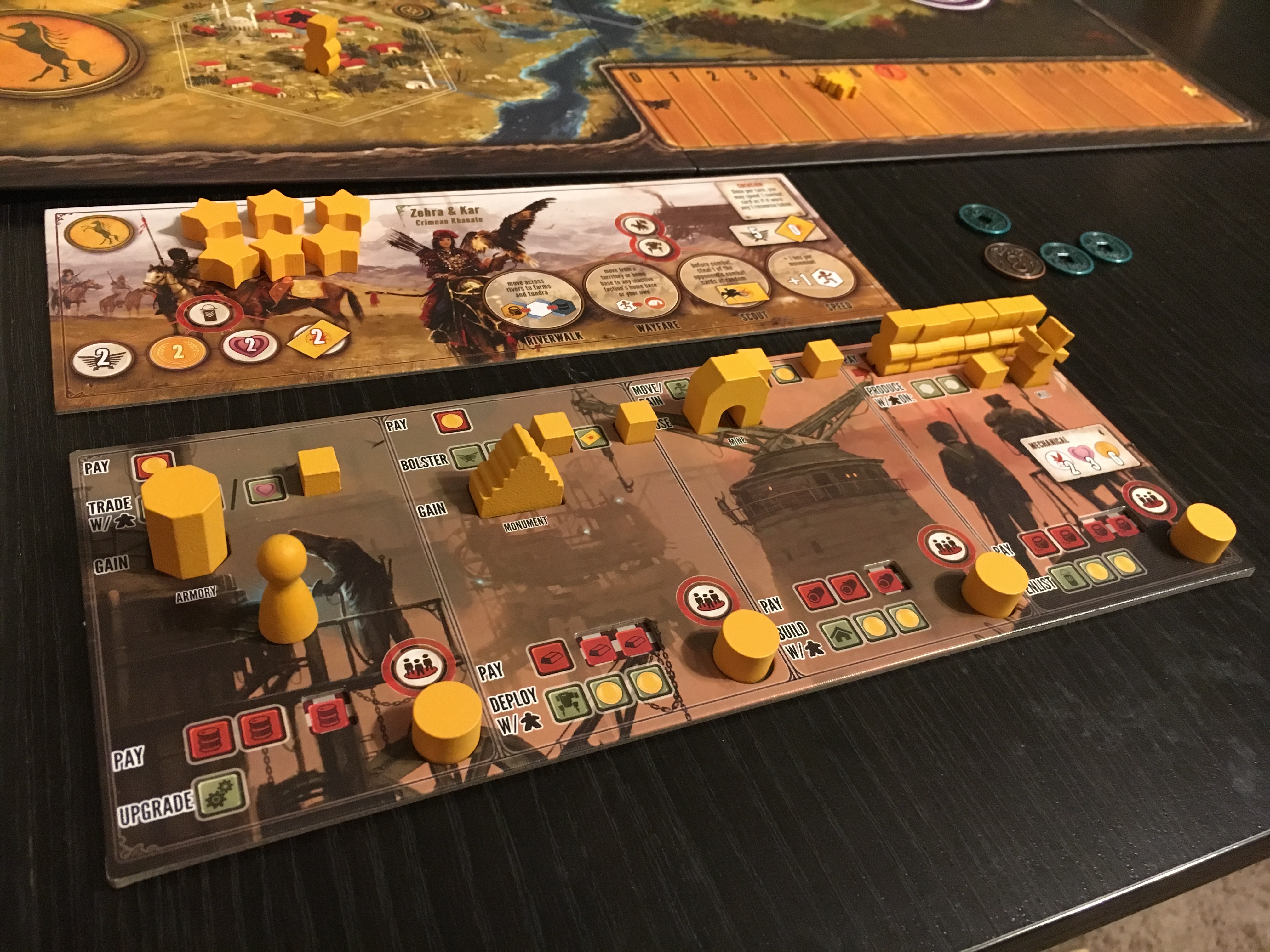
    Each player gets a randomly selected faction board which determines your starting military strength and the abilities your mechs can give you. You also start with a randomly selected player board which determines your starting popularity and money, and it also randomizes which of your top row and bottom row abilities are paired together and what the cost and reward is for some of those abilities.
    File_008

    Let me explain: On your turn you choose one of four sections on your player board. Each section has an ability at the top and the bottom. You can do one or both of these abilities, depending on if you can afford it. The abilities on the top row are generally free or cost a small amount of money and let you move or gather resources or power. The actions on the bottom row of the card cost resources that you have to generate or trade for and let you upgrade your faction or your production.

    As you take these bottom row actions, you move the wooden bits around on your player or faction boards and you start to quickly see the genius, and for me the extremely satisfying design of some of the components of this game. The top row actions you can take are; move (move your guys), bolster (gain combat power or money), produce (produce resources), or trade (trade gold for resources). The bottom row actions are; upgrade (upgrade two of your possible actions), build (build one of your four buildings), deploy (deploy one of your four mechs), or enlist (enlist one of the four soldiers you have access to). When you take your bottom row actions you take your wooden bits from the custom recessed spots they are in on your player board and move them around, revealing extra bonuses or abilities that you now have. In the instance of upgrading, you increase the output of one of the top row actions of your choice and reduce the cost of one of the bottom row actions of your choice. It is perfect. You get to get an instant and real time indication of how your little engine is upgrading as you make your choices.

    So while this is a game where you might not be able to afford what you want to do every time, or you may not be able to select the action you want, (you can not choose the same section on your player board two turns in a row) you do get to see how you are growing your faction with every successful action. You always feel like you are working to become more powerful and more effective. And in addition to that you can see it as your abilities get better with so many of your actions.

    From the moment I started moving upgrade cubes around and I was seeing how this made me better at the things I really wanted to do, I knew I was going to be very into this system.  That gives you a basic idea of what kind of things you have access to on your turn, but let’s talk about the things that make those things hard and require strategy to overcome. When you start, you can’t cross rivers or lakes, and your workers can only get the resource that is produced on the hex space on the board that they happen to be standing on. Since you only start with two workers on the board, and you only have access to three spaces that aren’t blocked by rivers or lakes at the beginning, you have to get strategic about getting the resources you need to go about doing what you want to do.

    The game gives you multiple options to spread out across the board and add more workers to the field, but it’s important that you are strategic about how you go about this. Why, you ask? Well, I am glad you asked! Because this is a great opportunity for me to explain one of the elements that adds the most balance to this game.
    File_004 (2)

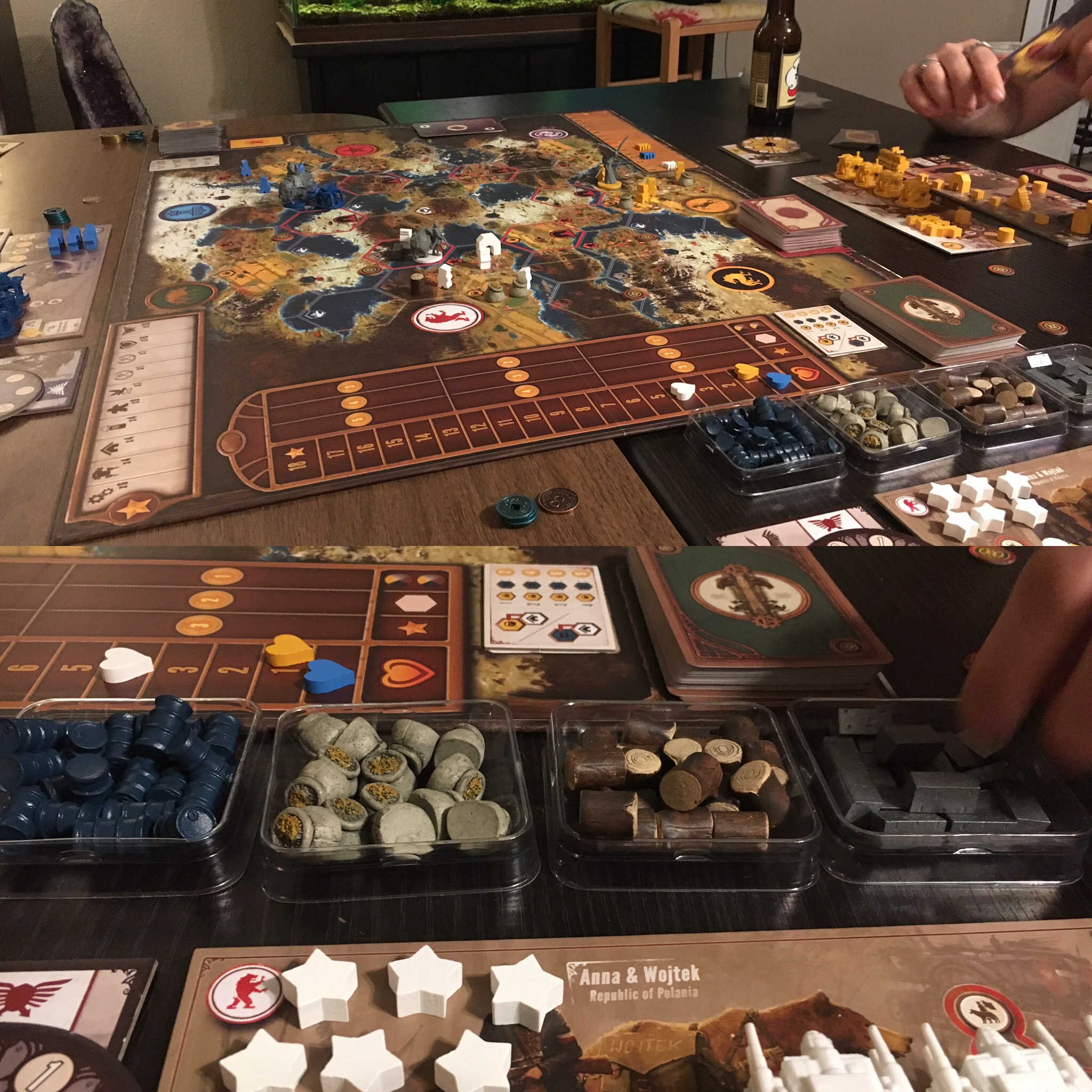
    There is a hard stop to this game, and that is when any faction places all six of their faction stars on the board. As soon as any faction places its sixth star, the game is over and end of game scoring commences. The great thing about this though, is that there are at least ten ways to earn stars in the game. So if you try to do everything well, you will inevitably fail in this game. You have to decide early on what six things you want to accomplish and hope that you can get to those six things before someone else gets their six stars out. Being the first to get your six stars doesn’t guarantee victory, but it sure helps, because stars out is the highest scoring category at the end of the game.

    The 10 ways of getting to put you stars out are; building all four of your buildings, enlisting all four of your troops, placing all eight of your workers on the board, upgrading all six of your action upgrades, winning combat (two stars max), completing an objective (one star max), deploying all four of your mechs, reaching the top of the combat power tack, or reaching the top of the popularity track.

    All of this means that as you are craftily plotting your domination or Europe, your opponent may be setting all the ducks in a row in order to get three stars on the last turn and suddenly the game is over and your next four planned moves are pointless. Game over, man. You have to be aware of how quickly this game can ramp to ending after a calculated and cautious build up toward a strategic victory.

    So how does one go about trying to get out there and get the resources needed to establish dominance and build the economic, industrial, agricultural, militaristic superpower they desire? Well, that’s simple. You just balance your placement on the board with your particular faction and economy type to craft the custom strategy you will need to be successful in each different application of this game.
    File_000 (4)

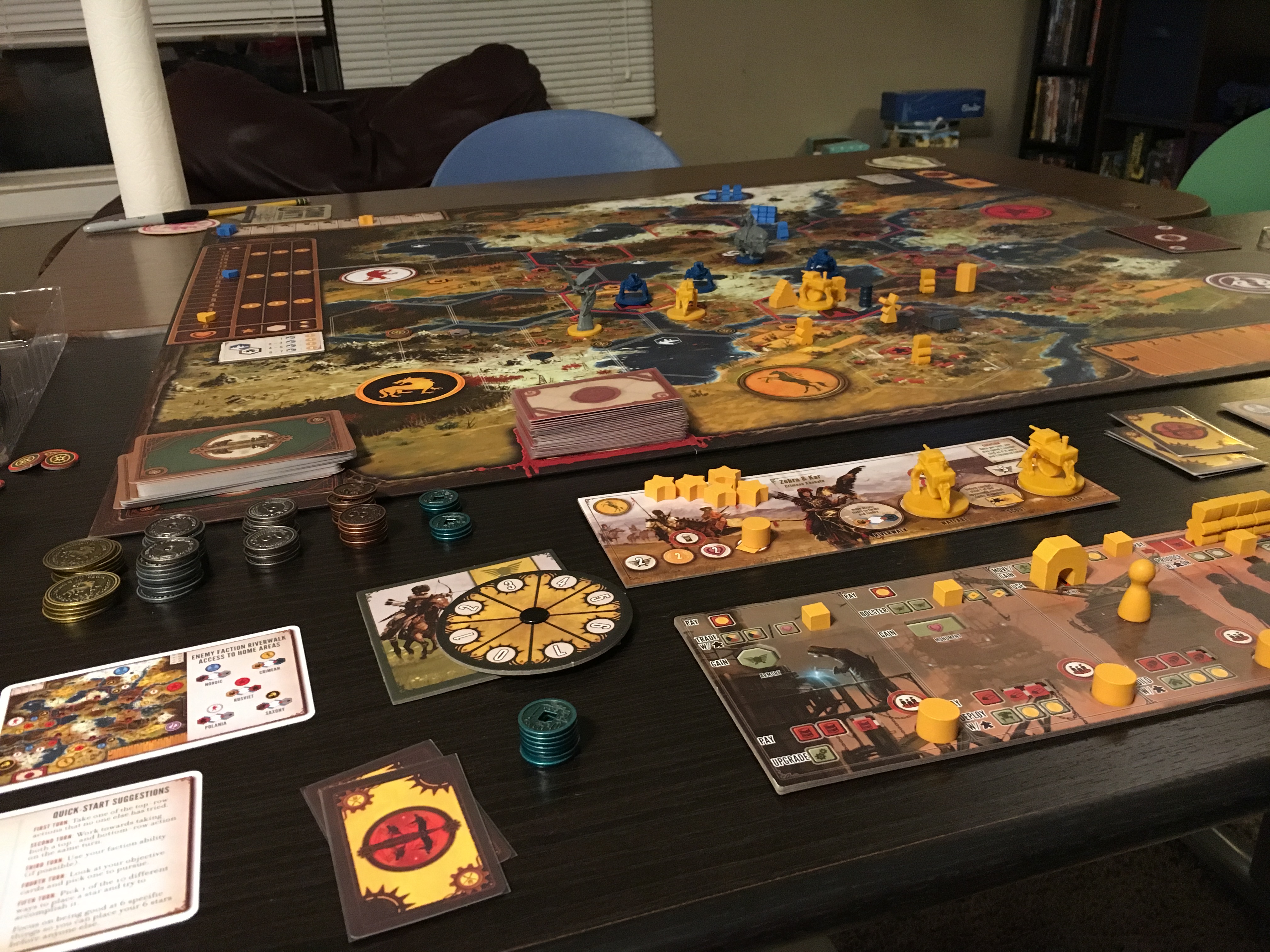
    What I mean by that is that is that it is so different every time that you won’t know precisely the strategy that your setup will require. It’s brilliant. Here are the five different faction abilities: You may select the same action two turns in a row, your workers can cross rivers, you may choose two rewards in encounters, you may gain unlimited stars from combat or encounters, or once per turn you may use any one combat card as any resource. So you can see that the faction abilities completely ignore or reverse certain rules. As the developer points out in the instructions, this also serves as a way to help remind the players of the rules, because you are remembering how your faction’s ability and the abilities of the other factions contradict the rules.

    So depending on your faction and player board, you might have to formulate a completely different strategy that you used last time you played this faction. The game can also dictate you needing to adopt a different strategy. If a certain player is making a bee-line for the factory and spreading wide across the board early on, you may have to focus on limited production and gaining might and popularity, eschewing enlisting or building your buildings.  If the players to your right and left are bolstering power and popularity early on, you may want to focus on enlisting to take advantage of the bonuses you’ll get when they build, deploy, enlist, or upgrade. There are so many ways to take advantage of your position and to get stars on the board.

    Add to all of this the fact that if your opponent chooses to, they can move a fighting unit into one of your zones with workers and the resources they have produced, and kick the workers out and take your resources, effectively drastically changing your strategy for the next few moves. But you have to be careful. For every helpless worker you kick back to the home base you lose popularity. Your popularity level also determines by how much your points are modified for stars, zones controlled, and resources left on the board when the game ends. So you really have to think twice before attacking another player’s workers.
    File_001 (1)

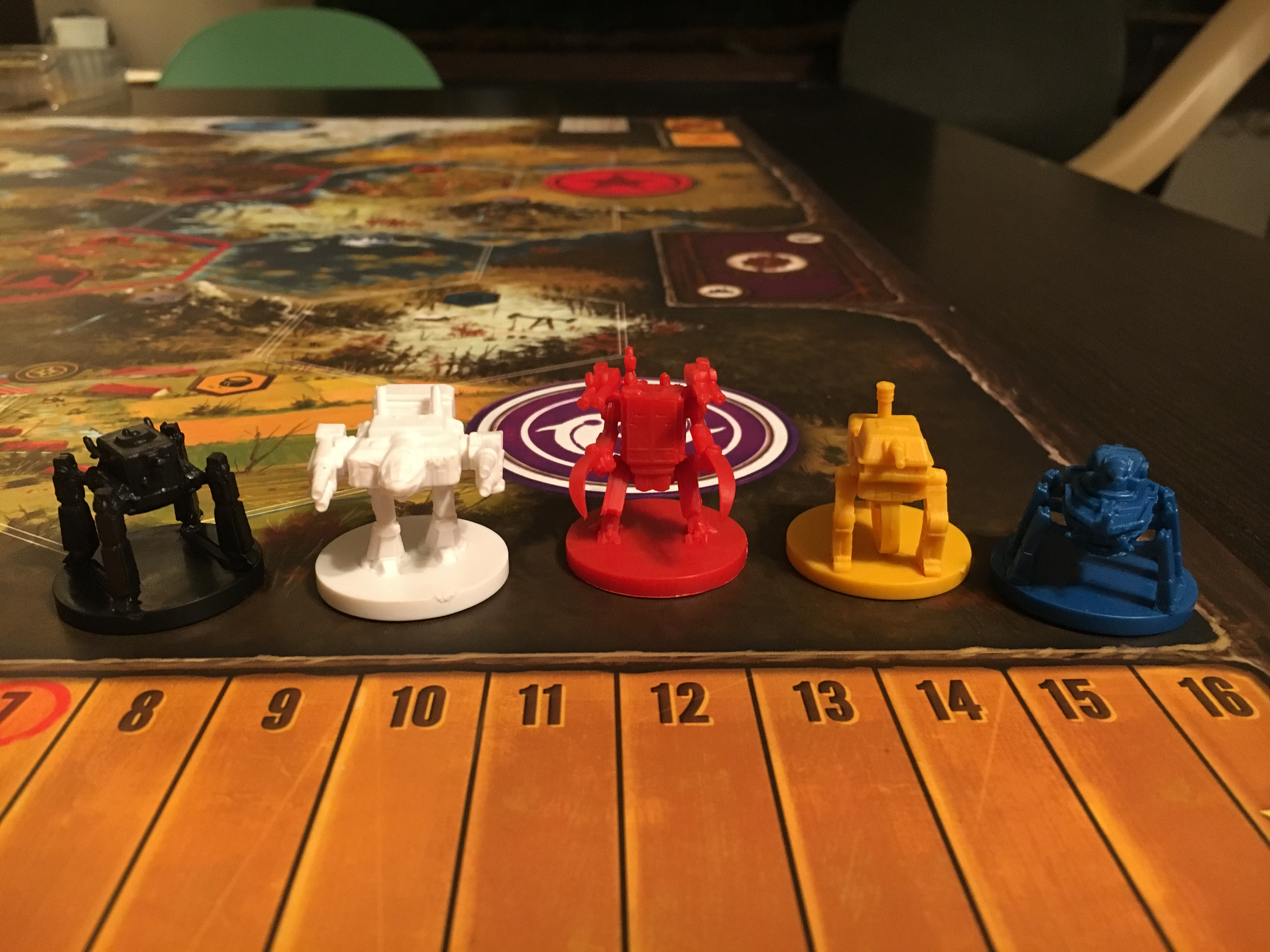
    If you happen to have a mech or your character figure guarding your resources, then you can fight back if someone decides they want to plunder your sacks of grain or your iron ingots. Then both players take their combat wheel and decide how much combat power they are willing and able to spend, and for each fighting unit involved in the combat they can choose to add to their power with a combat card. Whoever has the highest number wins, and takes control of that space on the board and any resources that happen to have been there. Plus, you can place up to two of your six stars by winning combat, even if you were attacked. But combat can be costly. Using up all of your power might leave you defenseless when it counts most. Building up combat power can take a while. And if there are any workers on the space that are forced to retreat to home base, you still lose that sweet, sweet popularity.

    This all means that the threat of combat is ever present, but it doesn’t happen all that much in my experience. I love how the game gets that so right. War is costly, and it won’t earn you any friends, but sometimes it is necessary to get what you want or to cement your place of power in the world. It feels like the perfect balance of conflict.

    “Then why even deploy your mechs?” You may be asking yourself. I’ll tell you why. Because the mechs each give you an ability. This lets any mech you construct and your player character take advantage of this new technology you’ve built for your faction. Every faction can build a mech that makes you move faster and lets you cross rivers, but each faction also has two mech that give you faction specific abilities. These range from things like letting you move into lakes and teleport to other lakes, to removing the popularity penalty for kicking workers off their spaces, to being able to add combat cards to your combat power for workers as well as fighting units, to being able to steal a combat card from a foe at random before combat begins. Suffice it to say, that building some of these mech can drastically change the way you approach the game, and these abilities really add another level of strategy to the game. Plus you get a star for deploying all four mechs, so it is definitely a strong strategy.  

    This game can seem daunting at first, and some of the iconography and terminology might be intimidating to some players. If you aren’t familiar with 4x games you might spend the first half of the game wondering what in the heck you’re supposed to be doing. But as you learn it and get more familiar with it you will realize that is one of the things about the game that makes it so great.

    You have so many options, and at the same time, you have to optimize them in order to be competitive at the end of the game. I love the push and pull. I love the depth and the balance of this game. When my brother and I were sitting down at our local game store to play with a couple of friends, a guy walked by noticing that we were setting up to play Scythe and we offered him the fifth spot. He quickly accepted and we started the game. We had gone around the turn order a couple of times and he remarked,

    “It’s so elegant. You don’t often see such elegance with such depth.”

    It is a perfect description of this game . Elegance and depth. Add to this the beauty and artistry of all of the components and you have an overall, completely enjoyable experience from the time you sit down, to the time you finish tallying the points at the end of the game. And as you sit contemplating how you could have been more efficient, and what you could have done better to maximize your faction ability and move your popularity into the third tier, you will realize that not only will you be playing this game again and again, but you are already planning it out. Just know that it won’t quite go exactly as you planned, unless it does. And that moment will be so gratifying.

    If you want a more in-depth tutorial, I will be uploading a how to play video soon.

    My sincere thanks to Jamey Stegmaier and Stonemaier Games for this amazing game. All images are used with permission of Stonemaier games and are the work of the incredibly talented Jakub Rozalski.

  • Karuba: A Puzzle Worth Solving

    Karuba: A Puzzle Worth Solving

    When I was growing up I remember being fascinated by the idea of being an archeologist. The Indiana Jones series and books about Tutankhamun’s treasure and Egyptian mythology fascinated me. I imagined a life where I could slowly crack the seal on the door of a tomb or stumble upon a hidden city deep within the rainforest and solve mysteries that were lost to history.

    Now I’m not going to talk to you today about an incredibly thematic game that will have you diving deep into the lore and mythology of a lost civilization, but I will be talking to you about a light and fun romp in the world of temple finding that appeals to both young and old. The game I’m speaking of is Karuba, a Spiel Des Jahres nominated game from this year that I like the most out of all three.

    Now if you are unfamiliar with the Spiel Des Jahres awards they are awards that are given out every year for children, family and advanced games that stand out among the thousands of games that are released annually. A committee of game experts in Germany reviews and votes for the best of each category each year. If you ever see a game with this symbol on the box:

    Spiel_des_Jahres.svg

    It means that the game was nominated for, or won the award. This also means that you will probably enjoy the game and wouldn’t be disappointed should you decide to purchase it. Some notable Spiel winners from the past are Catan, Carcassonne, Ticket to Ride, Alhambra, Small World, Kingdom Builder and Hanabi. All of these games are incredible, fun games to play.

    I want to say right off the bat that just because I think Karuba is the best game of the three nominees this year doesn’t mean the other two games aren’t also incredible, they are. This game just spoke to me for some reason in a way the other two didn’t. This was a tough year, all three games nominated were incredible designs that all deserve a place on your shelf. Recently my brothers and I had a “Spiel” night and played all of the nominated games that they hadn’t had a chance to play yet. After the night was done I asked “so which of these games do you like the most?” I picked Karuba, David picked Imhotep, and Chris stuck with Codenames. Do you see what I mean about all of the games being great? Each one of these titles will speak to each player differently as is illustrated by three guys in the same room playing the same three games, and each liking a different one the best.

    OLYMPUS DIGITAL CAMERA

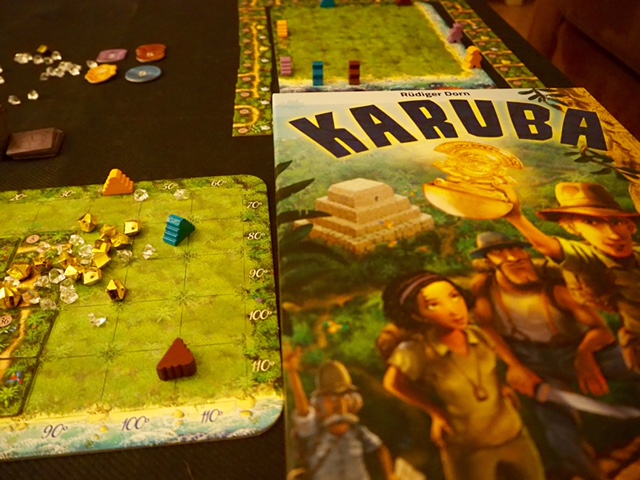
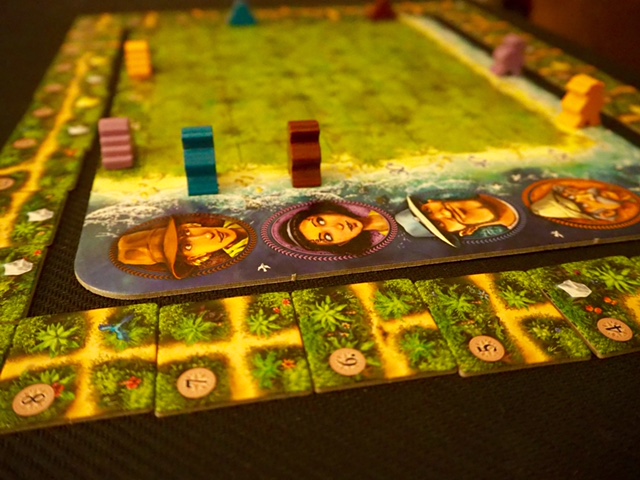
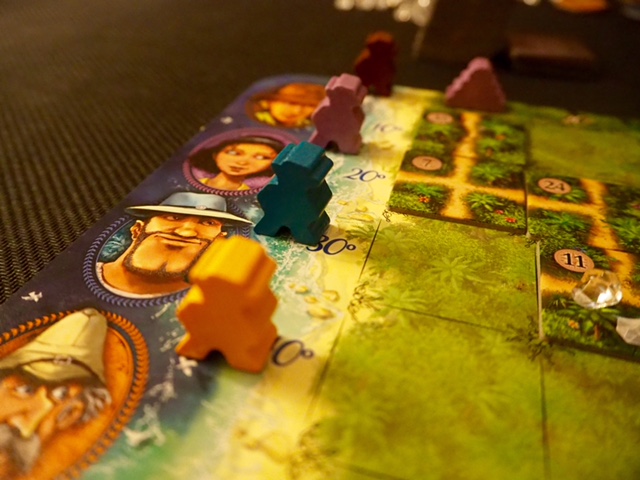
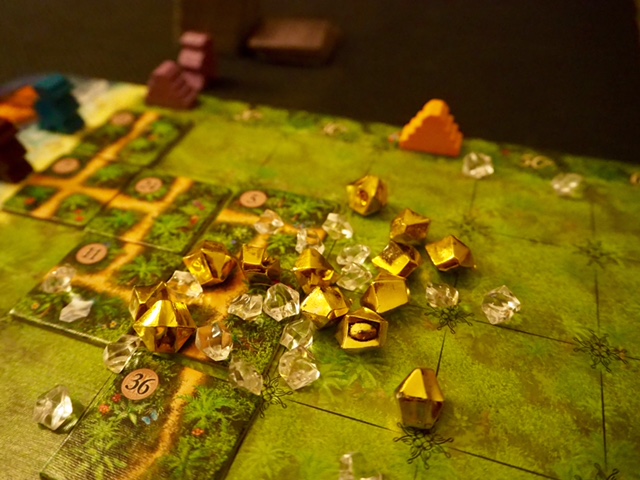
    Karuba is incredibly simple at its core. You and your opponents are each trying to move adventurer meeples to temples on the edge of your player board that match their color. Along the way you will collect gold and gems for extra victory points but the player who can reach the most temples in the shortest amount of time will usually win. Each player has their own player board (a jungle board with a grid of squares) and each player has thirty-six numbered tiles with roads on them and possibly gems or gold. The way a turn works is one player (who has been designated as the tile drawing player for the entire game) will draw a tile from a shuffled, face down stack of tiles and read the number on that tile aloud to everyone. The other players must then use that tile. Now you can either place the tile on your board as a possible path to travel, or you can discard it and move from two to four spaces depending on how the tile is laid out. After all tiles have been drawn or one player has reached all four temples the game is over and whoever has the most points wins.

    OLYMPUS DIGITAL CAMERA

    Based on the paragraph above you would think that this game is incredibly simple and would get old quickly. If you think that you would be mistaken. This game is strategically very deep and an incredible challenge. I think the reasons for this are many but I want to lay out a few of the things about this game that I think are very smart and well designed.

    OLYMPUS DIGITAL CAMERA

    The first thing that is incredible to me about this game is that all players start and continue to be on an absolutely equal playing field. Each player has to have their adventurers and temples in the exact same spots to begin the game and each player must choose to either place or discard the exact same tile each and every turn. What this means is that the person who wins this game is the person with the best strategy; nothing more and nothing less. There is no excuse for you to say “well if I hadn’t of drawn that card” or “man I just couldn’t roll a six”. This game is absolutely equal on all fronts. I absolutely love that. What that means is that you and up to three other players are seeing who can most effectively solve a puzzle and push their luck without dragging too far behind.

    OLYMPUS DIGITAL CAMERA

    One of the other things about this game that I think is brilliant is the fact that it limits your flexibility when placing tiles. Games like Carcassonne and Isle of Skye allow you to turn tiles any way you want and this ends up sometimes creating confusion and complications when scoring. Karuba forces you to think outside of the box of conventional tile placement and really think ahead before placing any tiles. You have to think about if the tile will work for what you need now, and also will the tile leave room for the expansion you need to have happen later in the game.

    OLYMPUS DIGITAL CAMERA

    Travelling in the game is also a delicate balance that takes a skilled player to achieve effectively. My first few games I would try to complete all my paths and then travel all at once before the end of the game and get as far as I could. The more you play the more you find that you have to maintain a delicate balance between travelling throughout the game and placing tiles in such a way that allows you flexibility but also allows you to place enough tiles to get each adventurer where they need to go. The entire thought process and play experience is deeply engaging.

    OLYMPUS DIGITAL CAMERA

    I haven’t played many HABA games in the past but this one is a winner on all levels. The theme is light and fun, the mechanics are simple but deeply satisfying, the production value is good and the plays can be done quickly which allows for multiple plays in a row. I would highly recommend this game to anyone who wants to engage their family and friends and also have a great time themselves. After almost ten plays I have rated this game as a nine on boardgamegeek and I don’t see that rating going down. The BGG rating scale for a nine absolutely says it correctly “excellent, very much enjoy playing”. I’ve posted a video below showing how the game is played. I hope you enjoy the content and until next time I’ll see you at the table.

    Paul

  • The Dicey Review Podcast Ep 3

    The Dicey Review Podcast Ep 3

    https://soundcloud.com/thediceyreview/dicey-review-episode-3

    Episode 3 of The Dicey Review Podcast where we discuss our time at BGG Spring! We discuss our tales from the tabletop and what’s been hitting the table.

  • Treasure Hunter: The Hidden Gem

    Treasure Hunter: The Hidden Gem

    When I was in college I remember the phenomenon of the hidden gem. That band that no one had ever heard of that had that sound that everyone needed to hear. The movie that was hilarious that was special because only you and your two friends knew all the punchlines to your inside joke. The funny thing about this trend for me was that the music and movies and video games that I found were cool until everyone else thought they were cool, and then I became jaded with them because they were too mainstream. Oh the mindset of our younger selves…it’s enough to drive one crazy.

    A few things have changed since I was in college about 5 years ago, including my taste in music. (By the way have you heard of a band called Lord Huron? Man they’re great you should check them out.) I’ve also gotten married, had a daughter and discovered an addiction that borders on the need for an intervention known as tabletop gaming. Hook line and sinker I have gotten involved in playing, collecting, researching, discussing, and reviewing tabletop games. The funny thing is, I’m still looking for the hidden gems. I hear plenty about the award winning games that top the geek lists but I’m still searching for those games that might have flown a bit under the radar or never really garnered the attention I think they deserve.

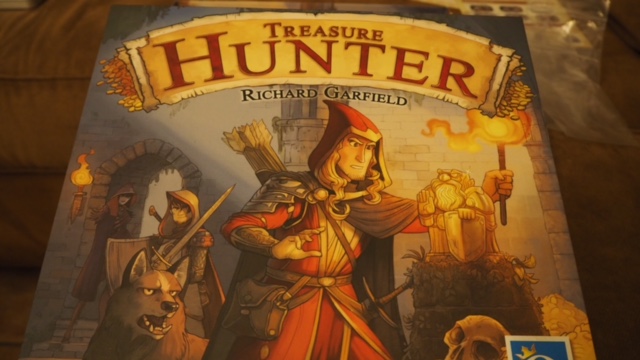
    I’ve discussed a few games recently that I think are really fantastic and not discussed enough due to the heavy hitters, but today I want to feature one in particular. The game is called Treasure Hunter. I played Treasure Hunter for the first time at BGG Spring in Dallas and absolutely fell in love with the game from the first hand of cards. This game is rated right under a 7 on BGG and I feel it should be a bit higher. The designer is Richard Garfield of Magic the Gathering fame. Treasure Hunter is a drafting game and if there’s one game designer who knows how to do card drafting it’s Richard Garfield. The artwork is fantastic, the component quality is very good, the gameplay is light but strategically interesting, and the playtime is usually under an hour even with six players.

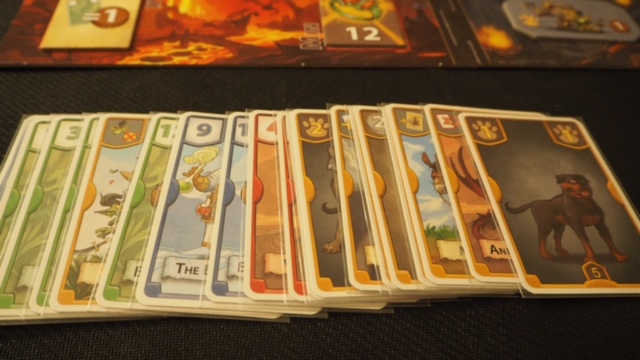
    In Treasure Hunter you will have three phases in the game followed by a fight with some Goblins. Over five rounds players will draft cards from a hand of nine. (Drafting a card means you look at a hand of cards you receive, pick one to keep, and then pass the rest to your opponents. You then take the cards given to you by your opponent, and repeat the process until the cards have all been picked.) You will compete with other players over a minimum and maximum treasure in a Blue, Green and Red landscape, and then try to escape with your treasures through a cave of waiting Goblins. The treasures that you are competing for can be worth either positive or negative points. Whoever has the most money at the end of the game wins! This game is easy enough to explain but has enough depth of play to make it very interesting, especially at higher player counts.

    OLYMPUS DIGITAL CAMERA

    What is it that I like about this game so much? I really enjoy drafting games. I’ve enjoyed 7 Wonders and Magic drafting previously but it’s hard to get other people in my family to engage in those two gaming experiences. Treasure Hunter has an approachable light hearted feel that doesn’t scare my family away, but is an engaging strategic drafting experience that provides me with the type of play I love. There is also a clear cut goal in this game. Get the most money.

    OLYMPUS DIGITAL CAMERA

    Now this is an interesting goal because of the different strategies you can employ. In each area there will be two options for treasure; potentially good or potentially bad. This in itself creates an interesting strategic problem to solve. Blue for instance may have a minimum treasure worth twelve points and a maximum treasure that will give you negative four points. This means that you might try to draft cards that keep your overall number in blue very low. You have to be careful though because if other players draft shrewdly, you may be passed a blue ten, or eleven as your last card. The last card handed to you has to be kept. Now there are cards that can cancel out bad cards that are handed to you so there is a way to draft defensively to prepare for the ram rodding that you are bound to receive. All of this thought goes into a seemingly simple game if you want to be strategic, or you can simply try for the highest treasure.

    OLYMPUS DIGITAL CAMERA

    You can also try to collect just money cards. In each hand of nine cards there may be a card that is worth a dollar or two or three. If you draft nothing but these cards you may miss out on the treasures that other players fight over, but over the course of the round you might have collected 10 to 20 points from money alone. You can also collect treasures that provide a one time use bonus. So for instance you may win a treasure tile that increases your dollar payout by one or two times once per game. You could collect that tile, draft nothing but money and then cash in a 30 or 40 point round.

    OLYMPUS DIGITAL CAMERA

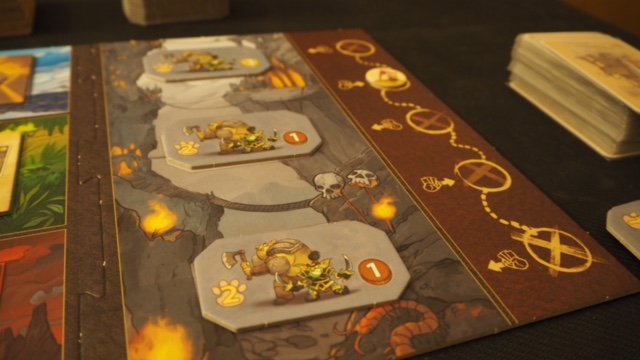
    You could also try and collect nothing but dog cards. After all players have tried to collect treasures, there are goblins that will try to steal some of your money. If you collect dog cards, they will defend you from these goblins. Each goblin has a strength of one or two or three (sometimes higher with expansions). If you collect dog cards with the strength that matches the goblin cards, you will pass by them without having to pay any money. If you don’t have dog cards that provide enough strength you have to pay the goblins the amount listed on their tile. The cool part is, whoever has the highest strength of dog cards will collect all of the goblin tiles, and any money that has been paid to them. So one round if the treasures are very attractive, players may forget about drafting dogs. You could then swoop in, collect all the dogs and collect all of the money the players have to pay out. Pretty neat move huh?

    OLYMPUS DIGITAL CAMERA

    There are also special cards that you can draft to provide bonuses and change your power in each color etc. I’ll spare the details on those to try and keep this from getting too boring! All of this is to say that for a game that is rated as a 1.8 out of 5 in complexity on board game geek, this game provides plenty of depth. Whatever approach you might take to the drafting mechanic this game will work wonderfully with your playstyle. Now I know that drafting games aren’t for everyone but this one has been a hit with most everyone that I’ve introduced it to. Some of my friends are pretty picky when it comes to tabletop games as well so that’s saying something. The arguments that I have heard against this game are:

    1. The game can be repetitive – My response to this is that some of the highest rated game of all time are very repetitive in their mechanics, but if the mechanics and gameplay are solid this isn’t a problem but a benefit. This game has very good mechanics that I haven’t gotten tired of yet after over twenty plays.
    2. The other criticism I heard from one of my friends was that “there’s not any strategy to this game”- my response to this is that it’s absolutely false. There is randomness to the game based on what cards are dealt to each player, but reacting to that and adjusting is the strategy. This creates such tension for the player and trying to determine if a bad card will be dealt to you and managing that risk is supremely strategic in my mind.
    3. Some people say the game can be too long – My response is that if 45 minutes is too much time for a board game that plays up to six then you aren’t going to like many board games.

    OLYMPUS DIGITAL CAMERA

    At the end of the day this is going to be one of my go to games for a quick, fun play that can accommodate a larger group and provide plenty of player interaction. This game hasn’t lost its luster after a good amount of plays for me, and I don’t see it happening soon. I would highly recommend picking up Treasure Hunter if you are a fan of fantastic designs. I’ve included a how to play video at the bottom of this post so you can see how the game flows and looks on the table. With any questions please email thediceyreview@gmail.com and until next time I’ll see you at the table!

    Paul

  • Why I Play Pokemon Go

    Why I Play Pokemon Go

    Such a great perspective on parents and their kids interests.

    Just Stephanie's avatarDaily Walking

    I am not a millennial, to say the least, nor am I in the other age group that loves Pokemon Go (children). My 57th birthday is this October, and I’ve never really gamed before, so if you’re wondering why I play the new game that’s taking over the world, this post is for you.

    img_0161

    It all started innocently. My 18-year-old son likes to keep me abreast of what’s going on. I’m grateful.

    Here is how the original Pokemon Go convo went down:

    Son:  Have you heard of Pokemon Go?

    Me:  Nope.

    Son: Nintendo’s stock is already up 10%, and it’s only been out a week. It’s done more in that week for youth fitness than Michelle Obama’s fitness initiative did in two presidential terms. You should play.

    Me:  Why would I do that?

    Son: Because it’s fun, Mom.

    Now, when he said the word “fun,” he was speaking my love language…

    View original post 333 more words

  • Vikings Gone Wild: A Walkthrough Review!

    Vikings Gone Wild: A Walkthrough Review!

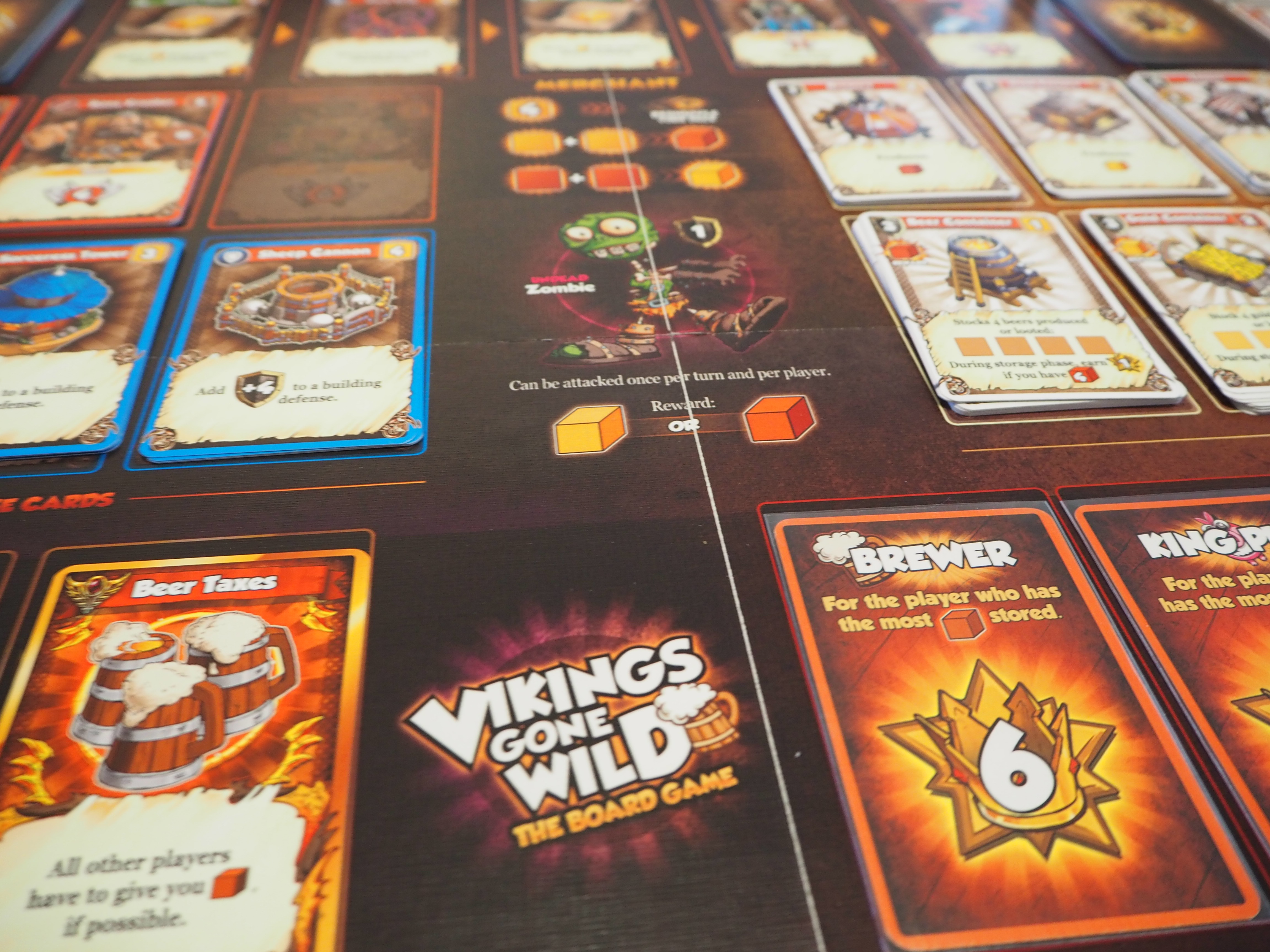
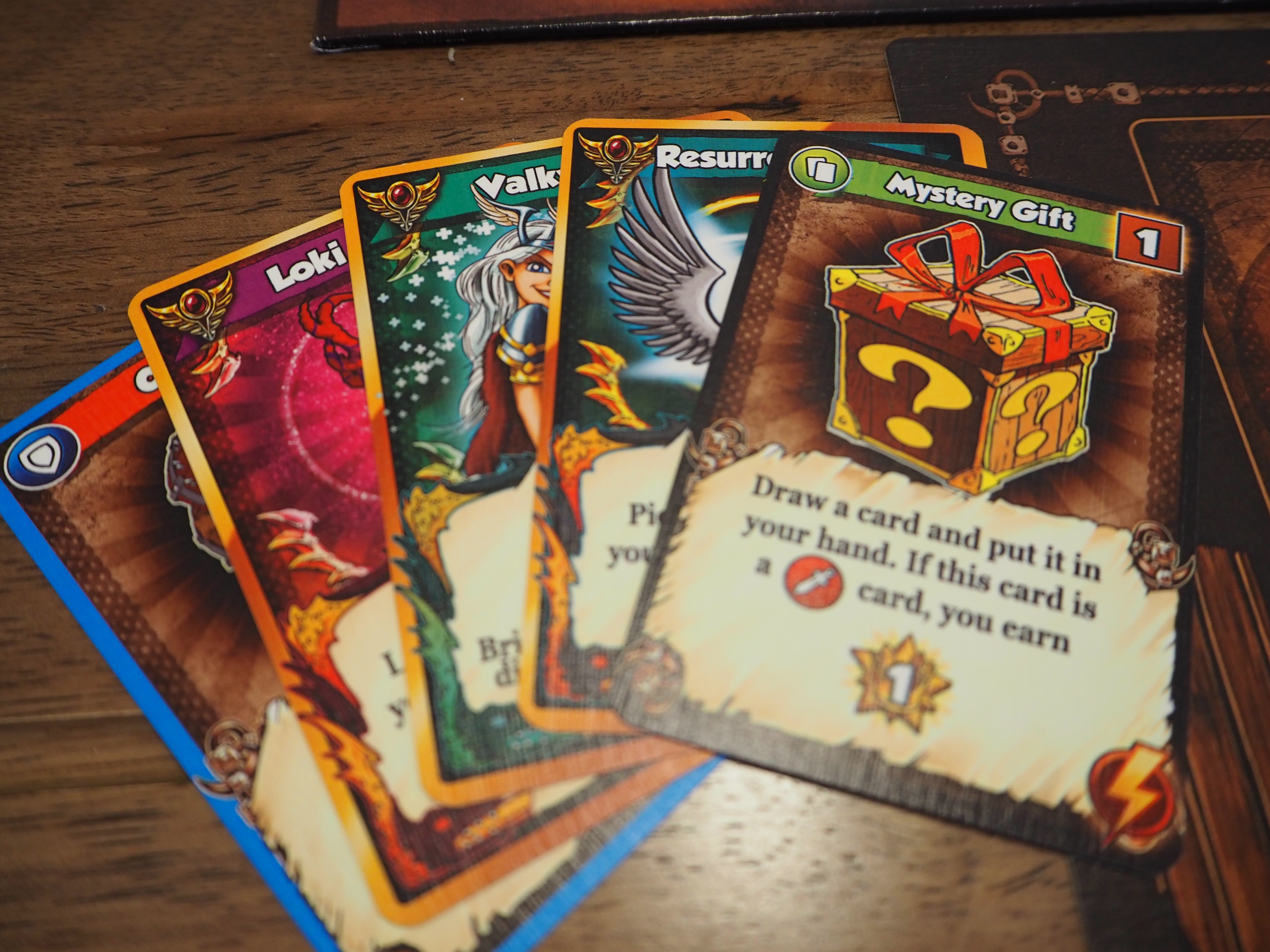
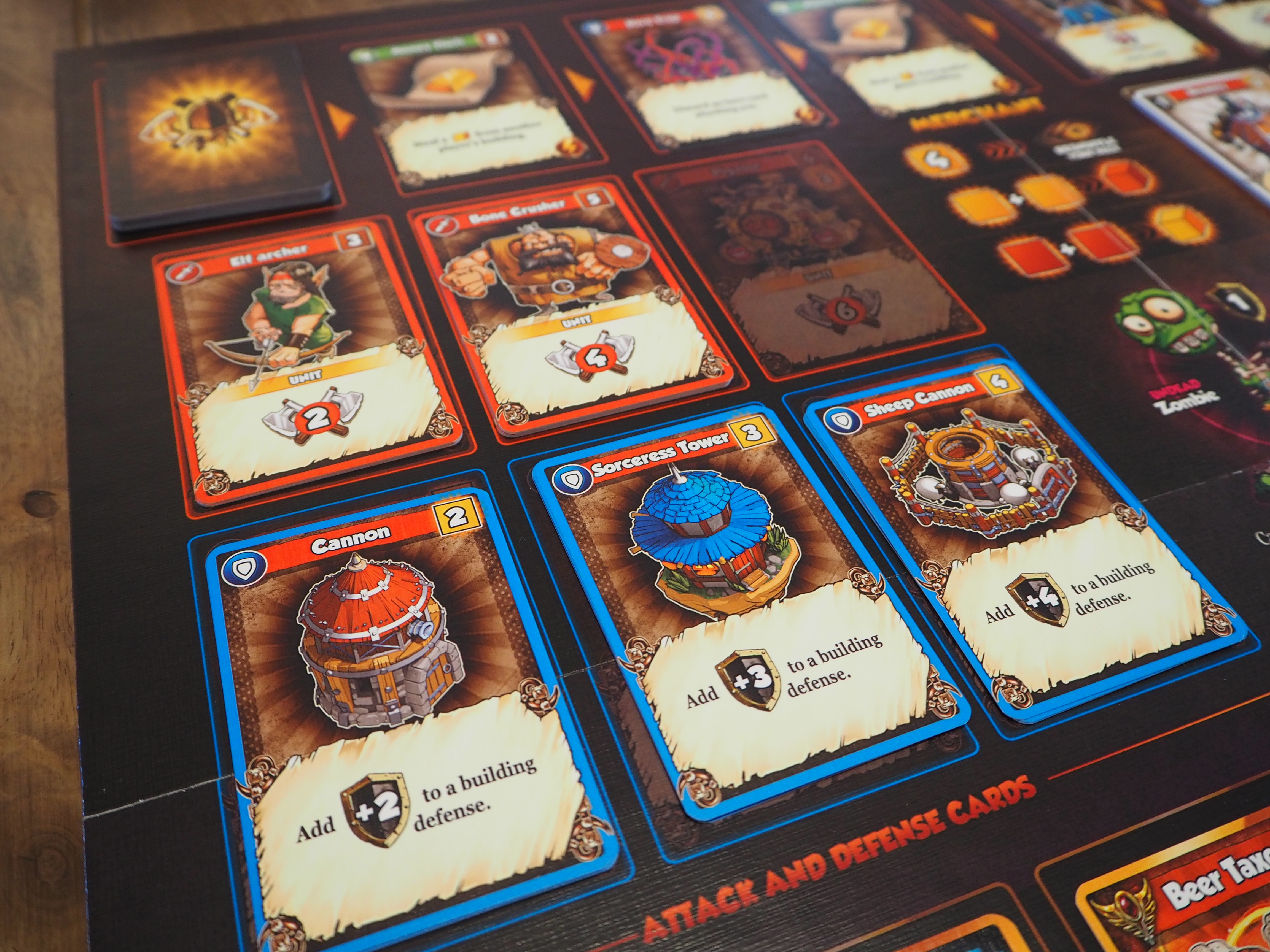
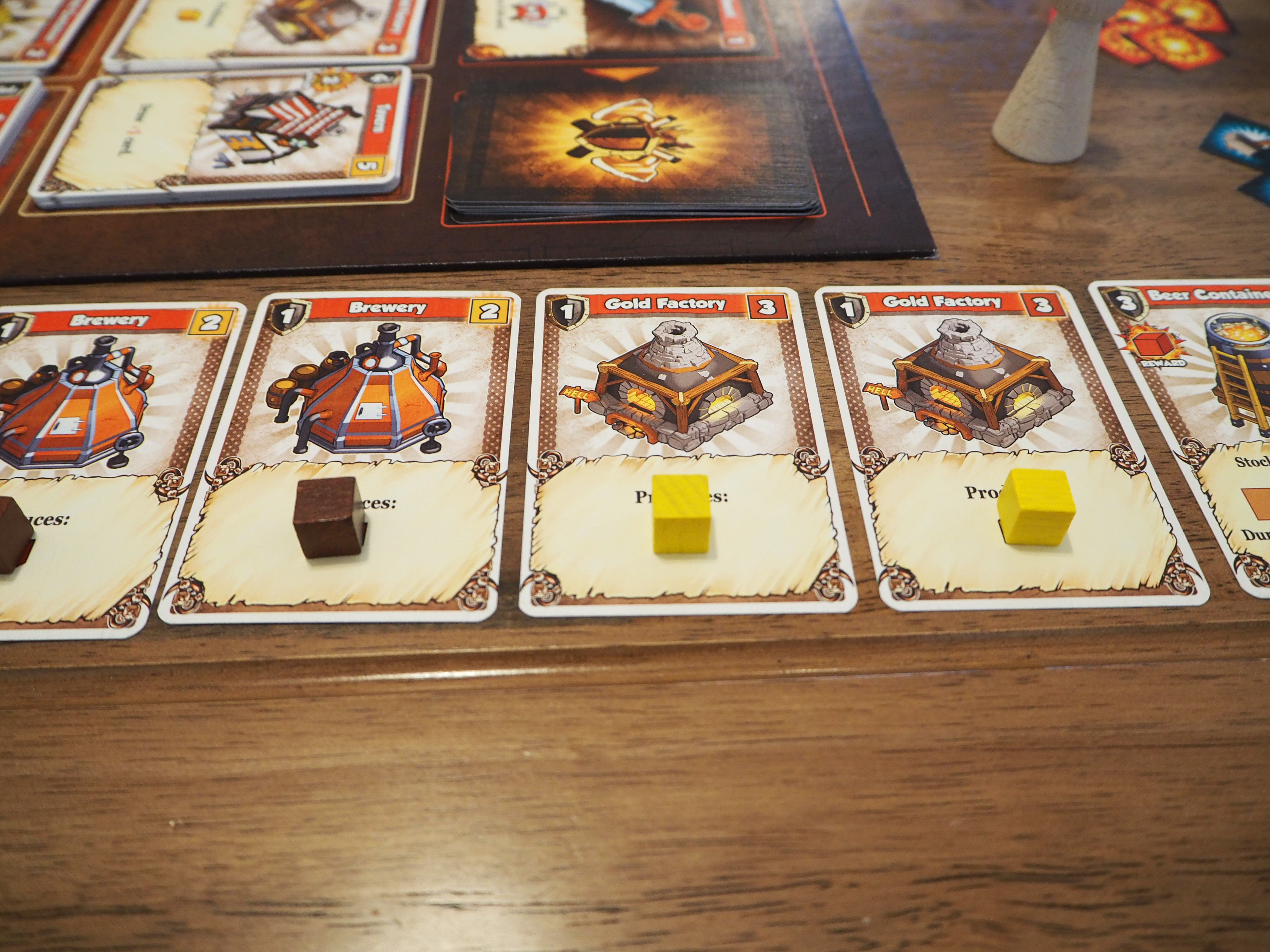
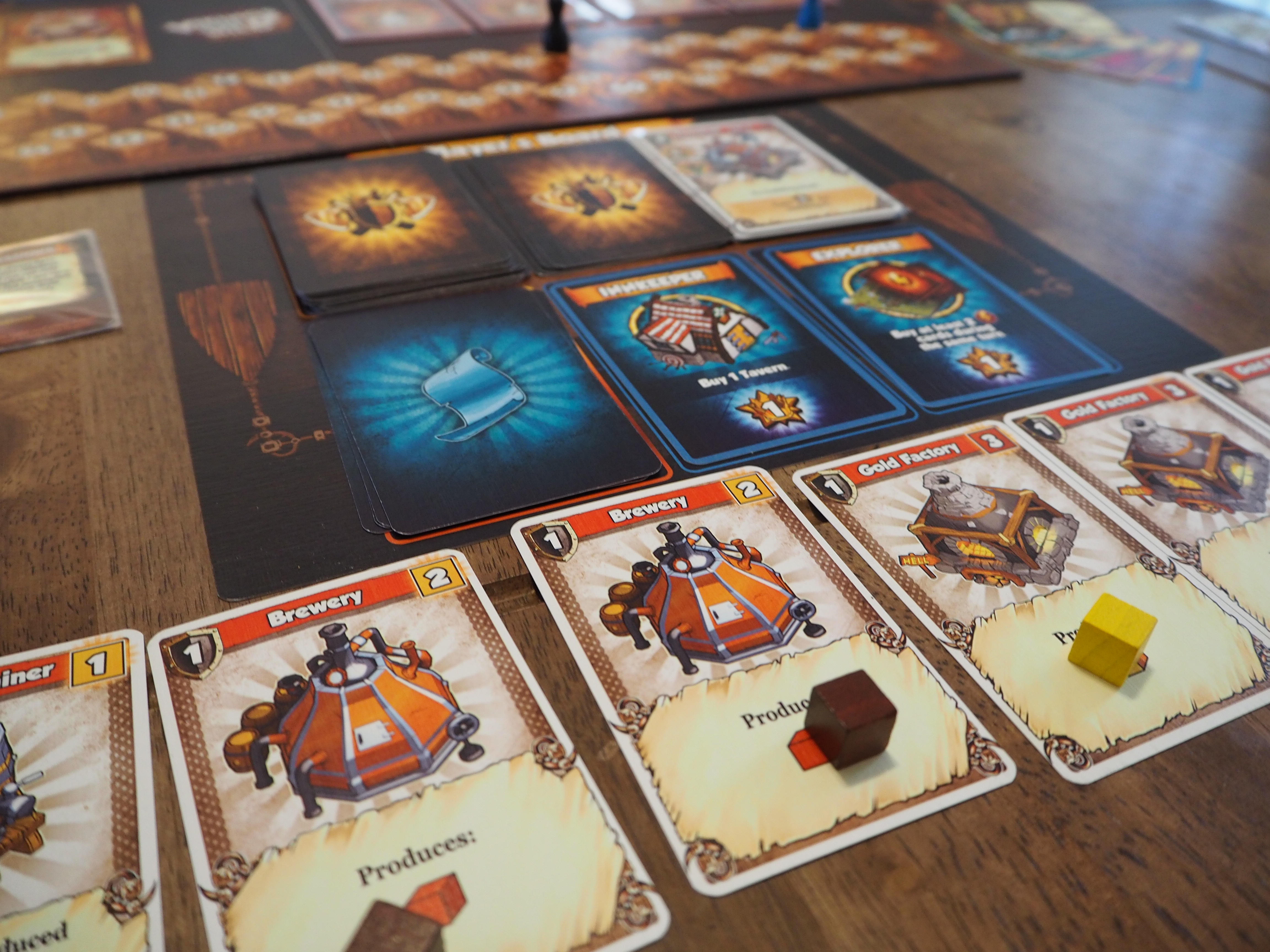
    Is there an alarming lack of pillaging in your life? Are you stuck in a dead end job that doesn’t allow you to raid your neighbors, collect gold and sail for glory and battle? Well you my friend might need to find a new career, and I can’t help you with that; but I can suggest a game that might give you the taste of barbarism that you’re looking for while still allowing you to maintain friendships and….not commit acts of war. The game is Vikings Gone Wild by Lucky Duck Games.OLYMPUS DIGITAL CAMERARecently my brothers and I attended our first board game convention in our neck of the woods in Dallas, Texas. BGG Spring happens every year around the Memorial Day Holiday. We were able to sign up for a demo of the game on Saturday and have Vincent Vergonjeanne, the CEO and founder of Lucky Duck Games explain the rules and gameplay. From the very first hand of cards drawn I knew I would like the game. OLYMPUS DIGITAL CAMERAWhat will you be doing in Vikings Gone Wild? You will be deckbuilding, village building, attacking your neighbors with Viking warriors, or defending your village from the onslaught of a neighboring clan. The basic machanics of the game are deckbuilding and hand management with aspects of things like set collection and resource management. Now if you are someone who glazes over when you hear the words “deck builder”, stay with me…I fully believe this game will win you over.OLYMPUS DIGITAL CAMERAI personally love deck building games. If you are someone who doesn’t enjoy the typical deck building experience you should still give this game a chance. There are a few things that separate Vikings Gone Wild from the pack, not only from the pack of deck builders but from games that I played at BGG Spring in general. One of the things that I loved about the game (besides the fact that I won) was the strategies for every play style that were all viable and felt successful. OLYMPUS DIGITAL CAMERAIf you like to build a village and manage resources and get bonuses for buildings in your empire there is an opportunity for you to do that. You can build locations that will produce Beer and Gold (the two currencies of the game), you can build locations that allow you to store excess resources (but watch out, these locations can be raided), you can build locations that allow you to draw more cards and keep extra cards from round to round etc. You will also have a town hall location at the start of the game. This building can be upgraded to allow you more buildings in your location. At the start of the game you can build 5 buildings, a level two town hall lets you build 8 buildings, and a level 3 town hall allows you to build as many buildings as you like. The only limitation is you cannot build more than three buildings of the same type. So for instance you couldn’t build all of the brewery locations and take that resource off the table for other players. There are many options for building your town. If you like to be passive and do nothing more than produce goods you can do it. OLYMPUS DIGITAL CAMERAIf you like to go raiding, there are more than enough warriors to meet your needs. Raiding can be a very successful strategy that can provide points for successfully attacking buildings, and you can also achieve bonuses for the more buildings you successfully raid per turn so the more powerful your army the more points you will earn. You need to be careful though because if the defending player has the cards to protect their village he or she will gain points instead and you will be left with a quivering lip. Don’t be too sad however, you can also raid locations on the board for assured resources and points. OLYMPUS DIGITAL CAMERAIf you like to mix up your strategy and try for cool combos with your deck you have the ability to purchase cards from the Odin’s Path track. These cards will provide interesting benefits like two of one type of resource instead of one or the ability to attack and draw cards. You can also gain benefits like reducing the cost of units to buy or looking at other player’s hands. Odin’s Path will be able to supplement any type of strategy you may use to make it more powerful. This track will also produce some cards that can be attacked for points, so there is a variety of useful bonuses this track can produce.
    OLYMPUS DIGITAL CAMERA
    Odin’s Path

    There are also Divine Favor cards that are very powerful, that you will earn by passing 5, 12, or 20 victory points. You will also gain divine favor cards by successfully attacking player’s upgraded town hall locations. Divine favor cards will be shuffled into your deck (just like purchased Odin’s Path cards) and will provide you with hugely useful bonuses. These cards may be mythical gods or creatures of legend that will help you and devastate your enemies. You could draw Odin, who attacks with two more power than the most powerful units. You could draw Loki who will attack and also steal from your opponent. There are also mythical beasts like Jormungandr who will attack and disable any Drakkar (boats) your opponent may have. There are also cards that will allow you to build units more cheaply, defend your resources or give you large amounts of resources of any type. The divine favor cards added a huge amount of strategy to the game that could be tailored to your personal preference and I loved that.OLYMPUS DIGITAL CAMERAThere are many other aspects to the game that make it enjoyable including missions that will give you bonus points, endgame bonuses for collecting the most of certain types of cards, and many other intricacies that playing will reveal. I must say that I hope you give this game a chance and pick it up. Vincent was a wonderful guy to meet and get to know, and the game was an absolute blast that we all backed on Kickstarter. The Kickstarter has ended but I was told that there will be an option to late pledge which I think you should do.OLYMPUS DIGITAL CAMERAI don’t want to tell you to go back a game that I don’t believe in so let me attempt to explain why this game was so fantastic. If you can’t tell from the explanations above, there is quite a bit of variability to this game. Not to mention the fact that if you back the Kickstarter you will receive over 110 cards and tokens added to the base game that already provides a vast amount of replayability. The nice thing about the variability is that it isn’t random. You will have different options to pick from based on cards that are drawn from the Odin’s Path and Divine Favor piles yes, but even if you don’t draw any of those cards you can still win with sound strategies. I love the fact that I can supplement my strategies but still control my own destiny in this game. There is a good amount of interaction in Vikings Gone Wild. If you are non-confrontational you can build lots of defenses and protect what you have but you will interact with other players and have battles and I find that wonderfully refreshing in a deck building game. There are many things about this game that I find wonderfully refreshing. The theme is great and has just enough humor to keep you smiling. The artwork is fantastic and the graphic design is very fun and makes you feel like you are playing the iOS game that the theme is taken from. With the amount of strategy, variable paths to victory, ease of access and wonderful presentation Vikings Gone Wild will win you over and should be in your collection. I absolutely recommend this game, I know that may mean nothing to you but I tend to pick games based on a different criteria than most. I have to think about games that my whole family will enjoy but will also make me feel like I’m getting the rich tabletop experience that I always look for. This game I fully believe will be a hit with my serious gaming friends, my wife, and my parents and in-laws. That’s due to the theming, approachability and depth of play.
    If you decide to pledge for this one, you will be out around $49 dollars for the version that I recommend. The $49 dollar deluxe edition comes with all unlocked stretch goals (over 110 cards and tokens), a large board that will add so much to the overall experience of the game, player boards for each player that will help you keep your space organized and 1100 online gems for the iOS game that this is based on. Overall with shipping you should pay under $60 in the U.S. and what you will be getting will be worth every penny and much more. I personally am going to try and add to my pledge to hit the $89 dollar level which will include 3 expansions. I love the game that much. Overall I rated this game an 8.5 on Board Game Geek which is to me an excellent game. I will recommend this game to anyone I can and play with whoever is willing. Back this game if you are at all a fan of board games. You can late pledge to the Kickstarter here:

    https://app.sneakpick.co/products/274-vikings-gone-wild-late-pledge-limited-time

    I’ve also included a how to play video below so that you can see some of the components (not final quality) and how the game works. I hope you enjoy the review, and until next time I’ll see you at the table.

    Paul

  • The Dicey Review Ep 2.5

    The Dicey Review Ep 2.5

    A filler solo episode while I fix some audio and timing issues with our full episode 3 of the podcast. This episode includes a tale from the tabletop, some what’s happening in the industry, roll the dice and an analysis paralysis topic as well as some games that I have been playing!

  • The Dicey Review Podcast Ep 2

    The Dicey Review Podcast Ep 2

    Episode 2 of The Dicey Review Podcast where we discuss what’s been happening in the industry, tell our memorable play experiences and discuss theme in gaming.

    Podcast Cover Art


    Until next time we’ll see you at the table!

    Paul

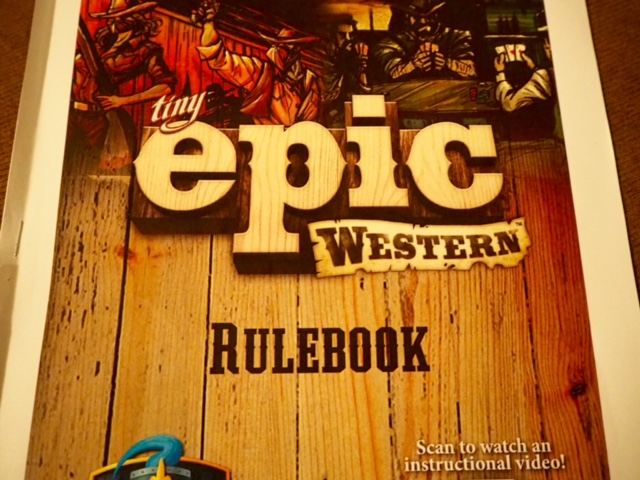
  • Tiny Epic Western – A “Walkthrough Review”

    Tiny Epic Western – A “Walkthrough Review”

    It’s high noon. Some of a rival posse’s thugs are hanging around your waterin’ hole. Looks like it’s time to teach them a lesson they won’t soon forget. You step down main-street determined to leave the saloon dead or alive. Your foot falls in time with the beating of your heart, leaving a cloud of dust with every thud. A tumbleweed dances across the road leaving a snake-like trail behind and everything slows to a crawl. Your ears ring as the sun beats down on your brow, a drop of sweat slowly crawling its way down your left temple. From the front door of the saloon a lean, middle-aged gaunt man steps out and turns to face you. He knew you were coming. In his eyes you see nothing but the cold, calculating stare of a man sizing up a target. You can tell he’s done this before. “That’s alright” you think to yourself…I’ve given the same look to many a man. Two souls….hands outstretched stiff like a board next to their side…one person breathing his last few breaths. As quick as lighting both hands reach for their holsters and pull out their trusty….DICE?!

    OLYMPUS DIGITAL CAMERA

    That’s right everyone it’s time for another feature review of a new game that I’m very excited about: Tiny Epic Western! Tiny Epic Western is a dice rolling, worker placement, poker playing, rip’ roaring good time for 1-4 players that takes about 30-45 minutes to play.

    If you’ve never heard of the Tiny Epic Series you are missing out. Gamelyn Games approaches different mechanics in unique ways to create rich gaming experiences focusing on certain gameplay aspects. Mechanics like Area Control, Dice Rolling, Co-op play, Action Selection and Variable Player Powers are all approached in a wonderfully concise and portable way. All Tiny Epic games come in a small box for a reasonable price but provide surprisingly deep play for the size of the package.

    OLYMPUS DIGITAL CAMERA

    The newest installment: Tiny Epic Western is Gamelyn Games’ shot (pun intended) at Worker Placement. Worker Placement is my favorite mechanic and so my ears always perk up when I hear a new idea involving it. Tiny Epic Western really made me sit up and say “oooo” because they have combined worker placement with poker. When I saw the Kickstarter page listing this I thought that thematically this was a very cool choice, and that the choice to include poker was a good decision because it also creates a sense of chance. This makes a seemingly simpler mechanic like worker placement seem much more interesting because you aren’t always simply benefiting right away from a spot when your worker is placed, sometimes you’re gambling for it.

    OLYMPUS DIGITAL CAMERA

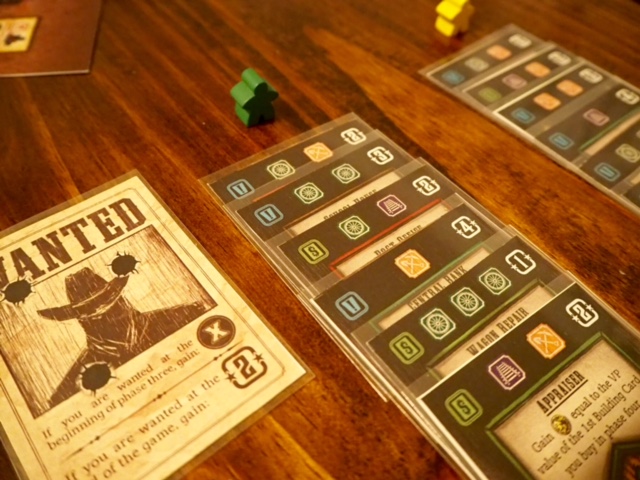
    Although this is a worker placement game it doesn’t utilize one of the most common worker placement traditions where you can block a spot by assigning there. Quite the opposite, you are encouraged to go to locations where other players already reside. When you want to place a worker on a location where an opponent’s worker has been placed, you start a duel that will end in one person becoming wounded and the other person becoming the winning posse member at this location. When you win a duel you get the “Wanted” card. This card will benefit you with influence (the game’s form of currency) and victory points at the end of the game.

    OLYMPUS DIGITAL CAMERA

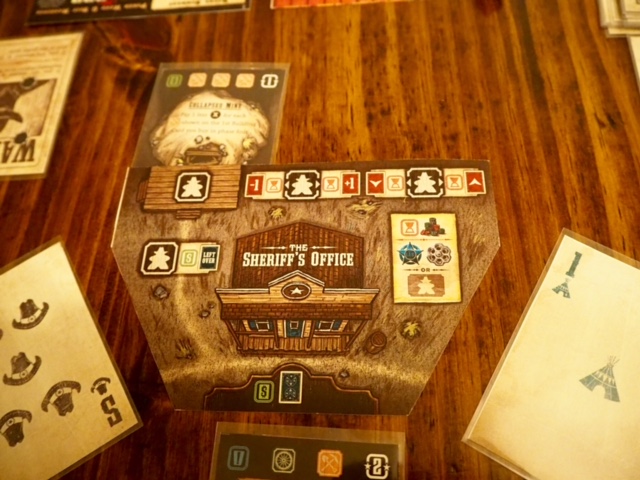
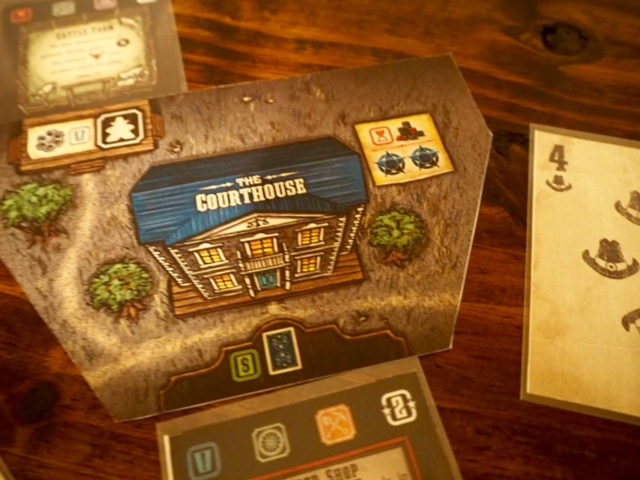
    Tiny Epic Western pits players as leaders of posse’s that roam a western town increasing influence and gaining reputation as they duel and gamble their way through the different locations around the map. Players will begin the game by choosing a character that will give each person a special ability that will be helpful throughout the game. You will pick a color and this color will give you a location within the town that is associated with you. The goal of the game is to have the most victory points and they are acquired through buildings that you can buy as well as shares in an industry track that you can manipulate throughout the six rounds of play.

    OLYMPUS DIGITAL CAMERA

    This game has so much interaction because of the dueling mechanic and the locations that players will come to that you have purchased. Even when it’s not your turn you are always engaged and I find this to be hard to achieve and a goal that many tabletop games fall short of.

    Overall this game is hard to beat. It’s a Tiny Epic game which means a couple of things. First, it will be in a box that can easily fit in a purse, backpack, briefcase, or if you are a person who wears cargo shorts, your pockets. Second, it will be reasonably priced (usually around $25) so the game won’t break the bank. Due to the size of the box and price point of the game many game stores will put this game with their filler section and micro games but please don’t be fooled by this categorization. There is no filler in this box. This is a deep strategic experience filled with player interaction and “take that”. I love a good western theme and the mechanics that were designed into this experience fit perfectly and help achieve a gunslinging good time.

    OLYMPUS DIGITAL CAMERAOLYMPUS DIGITAL CAMERAOLYMPUS DIGITAL CAMERAOLYMPUS DIGITAL CAMERAOLYMPUS DIGITAL CAMERA

    I backed this game on Kickstarter because I loved the idea of what the designer and publisher were going for. I backed the game at the deluxe level which will get me a more polished product and I’m very excited about that. I was able to access a premium print and play file because of my backing status so I have been able to play the game early and I am loving that option. I can’t speak to the quality of the final components because I am using my print and play files but if previous Tiny Epic games are any indication the quality of the bits and cardboard in the box will be excellent.  The artwork is incredible and creates a wonderful old west feel in the players around the table.

    Overall this game is a wonderful experience and one you should look for at your friendly local gaming store when it releases later this year around October. You can also pledge late to the Kickstarter by going here: https://gamelyn.pledgemanager.com/projects/tiny-epic-western/join/.

    I’m amazed by the work that Gamelyn Games is doing and think you should support this game and any other Tiny Epic games you can find in stock. Also be on the lookout for Heroes of Land, Air and Sea which will Kickstart some time early 2017. I’m very excited about what’s in the works for this company and you should be too. If you want more in-depth knowledge about how the game plays and looks on the table I have posted a how to play video at the bottom of this article. I hope you enjoy the video and until next time I’ll see you at the table.

    Paul